01What the rock is
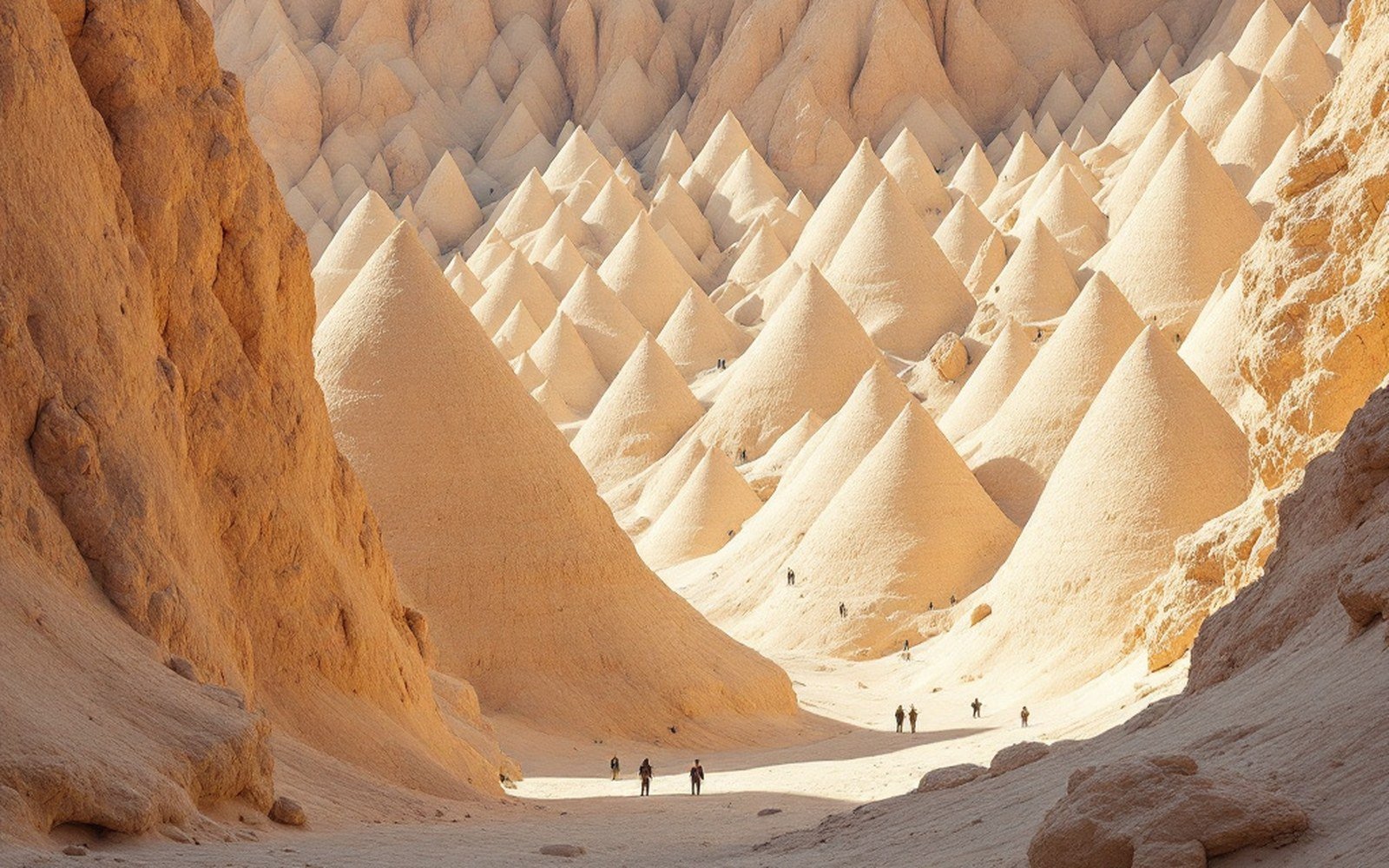
The cones stand on the Pajarito Plateau about 40 miles southwest of Santa Fe, near 35.67°N, 106.43°W, where the Jemez Mountains spill their oldest debris onto the rift's western edge. Their raw material is the Bandelier Tuff — the compacted ash and pumice ejected from the Valles Caldera in two major eruptions roughly 1.61 million and 1.25 million years ago. What makes Kasha-Katuwe (a Keresan phrase meaning "white cliffs," used by Cochiti Pueblo) unusual is that the sequence preserved here includes not just the dense welded tuff at the top but also thick beds of loosely consolidated pumice lapilli and ash below it. Pumice is volcanic glass foamed to near-weightlessness by trapped gas; in the Bandelier sequence it accumulated in sheets before heat and pressure fused the uppermost layers into a harder, more resistant cap.
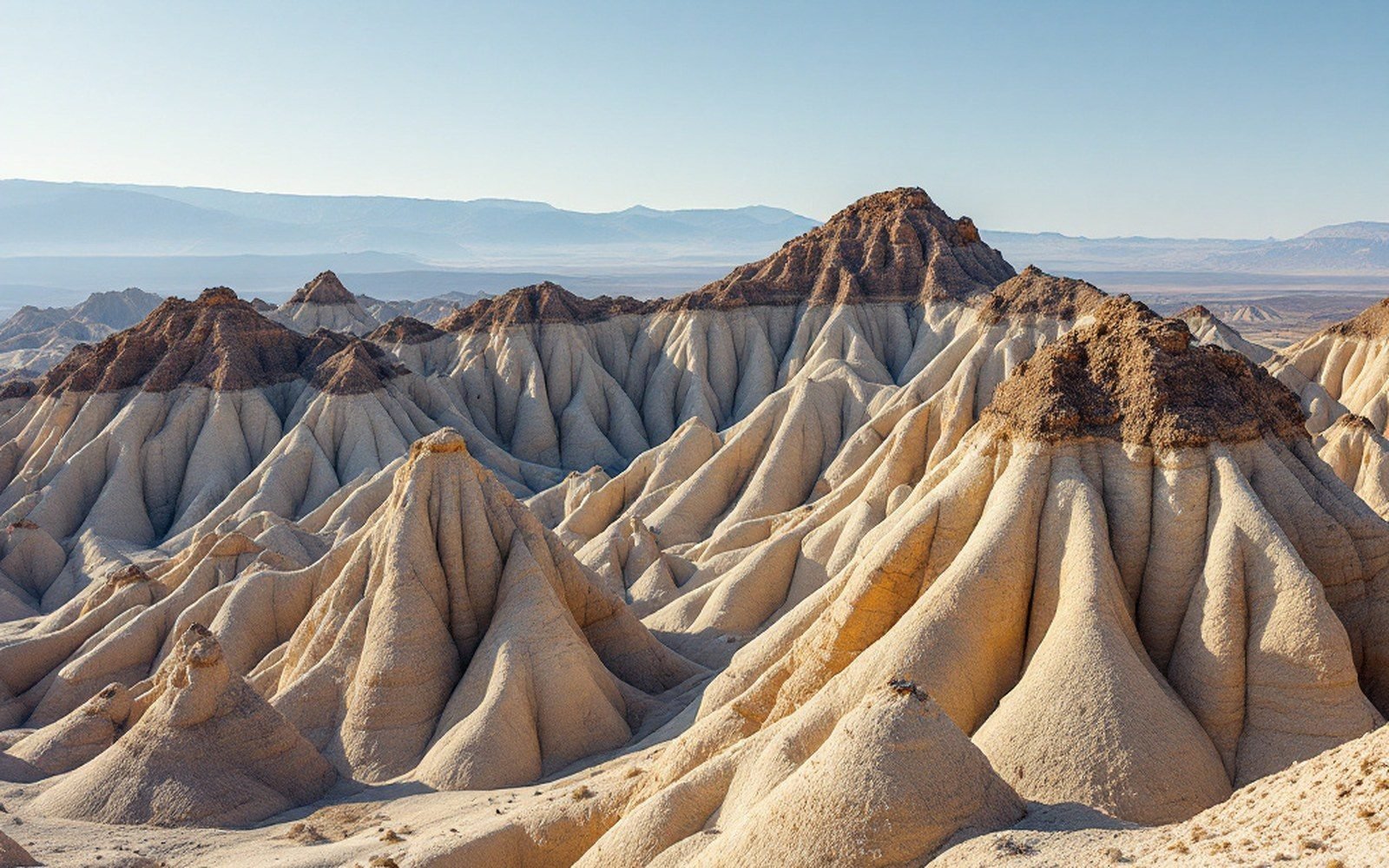
The stratigraphic logic is simple: the welded tuff resists erosion, the pumice below it does not. Where a block of the hard cap survives, it slows the loss of everything beneath it. Where the cap has gone, the soft material weathers quickly. Over hundreds of thousands of years, water and wind have carved the pumice into tapering pillars — the tent rocks themselves — each one topped by the fragment of welded tuff that bought it time.
02How the cones form
The process is differential erosion, operating on a vertical stack. Rain hits the unprotected surface and carries pumice grains downslope; the protected cone beneath each cap erodes more slowly and on all sides, so it tapers toward the base of the caprock rather than beneath it. The result is a cone that narrows upward to the hard block — sometimes a boulder of dense tuff perched on a point that looks incapable of holding it. When the cap finally falls, the pillar beneath begins losing height rapidly and will eventually disappear.
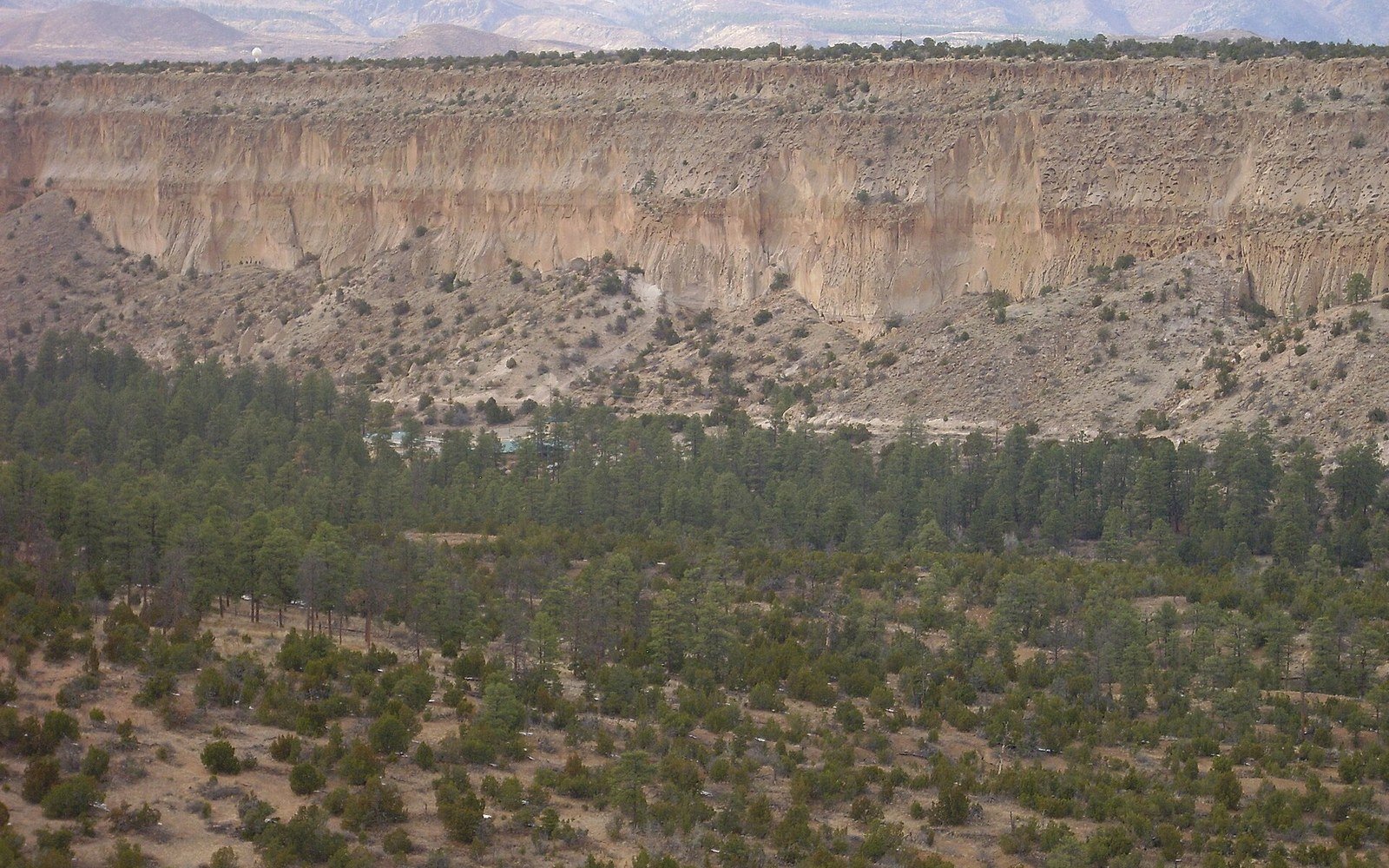
The canyon walls expose the same sequence in section. Visitors walking the slot canyon cut through the monument are moving through the interior of this tuff pile: the walls are stratified pumice, occasionally stained by iron or manganese oxides, and the ceiling, where it narrows, approaches the underside of the welded layer above. The forms called hoodoos — a broader term for any differential erosion pinnacle with a cap — are the canyon's isolated counterparts on the open slopes.
The scale of what produced this landscape is worth holding in mind. The eruptions that generated the Bandelier Tuff released material that blanketed much of northern New Mexico; the ash sheet reached far beyond the Jemez Mountains. Kasha-Katuwe preserves a relatively proximal section of that deposit, close enough to the caldera that the pumice beds are thick and coarse. At greater distances, the same material thins and the grain size drops, giving way to finer-grained tuff in more distant exposures of the Bandelier Tuff.
The result is a cone that narrows upward to the hard block — sometimes a boulder of dense tuff perched on a point that looks incapable of holding it.
03Desert varnish and what outlasts the rock
On the harder basalt surfaces nearby and elsewhere along the rift's margins, desert varnish — a dark manganese- and iron-rich coating deposited slowly by microorganisms and windborne minerals — accumulates over millennia and provides a surface that holds a record. The pumice cones at Kasha-Katuwe are too soft and too actively eroding for varnish to form; the record there is purely physical, not cultural. The contrast matters. Where basalt and desert varnish coincide, as on the West Mesa escarpment to the south, the rock holds images. Where soft tuff dominates, the rock holds only the geometry of its own destruction.
The National Monument is managed by the Bureau of Land Management in consultation with Cochiti Pueblo, whose ancestral connection to this landscape is substantive and continuous. The Keresan name the site carries is not decoration — it is the original description, and the correct one. The white cliffs are white because they are largely unvarnished pumice, pale and fresh-looking despite their age, surrendering their material grain by grain to the same rift-driven climate that built them.